Traceability is not merely scanning a barcode or keeping a shipment list. In a food plant, it means that data moves without breaking from supplier lot to receiving record, from recipe version to work order, from quality decision to customer shipment.
A strong system answers “which customer received which lot?” in minutes. More importantly, before any crisis occurs, it gives daily control over waste, rework, shelf life, nonconformity and supplier performance.
ManuFox approaches this through the real food-production workflow: materials, stock, recipes, production, quality control, shipments, costs and traceability share the same data backbone.
What traceability must cover
Food traceability is the ability to follow a product and its ingredients through production, processing and distribution by means of reliable records. It therefore has to cover both the external supply chain and the internal transformations inside the plant.
A good traceability system answers three questions at once: which raw-material and supplier lots were used backward, which finished lots and customers are affected forward, and which process or quality decisions touched the product inside the factory?
- External traceability manages supplier and customer links.
- Internal traceability connects production, loss, rework, semi-finished goods and quality decisions.
- The lot identity is the common key for every record.
- When the recipe version changes, old and new productions must be separated.
- Shipment records must show not only quantity, but also finished lot and customer.
- Reportability determines the practical value of the system.
How to design a lot-based data model
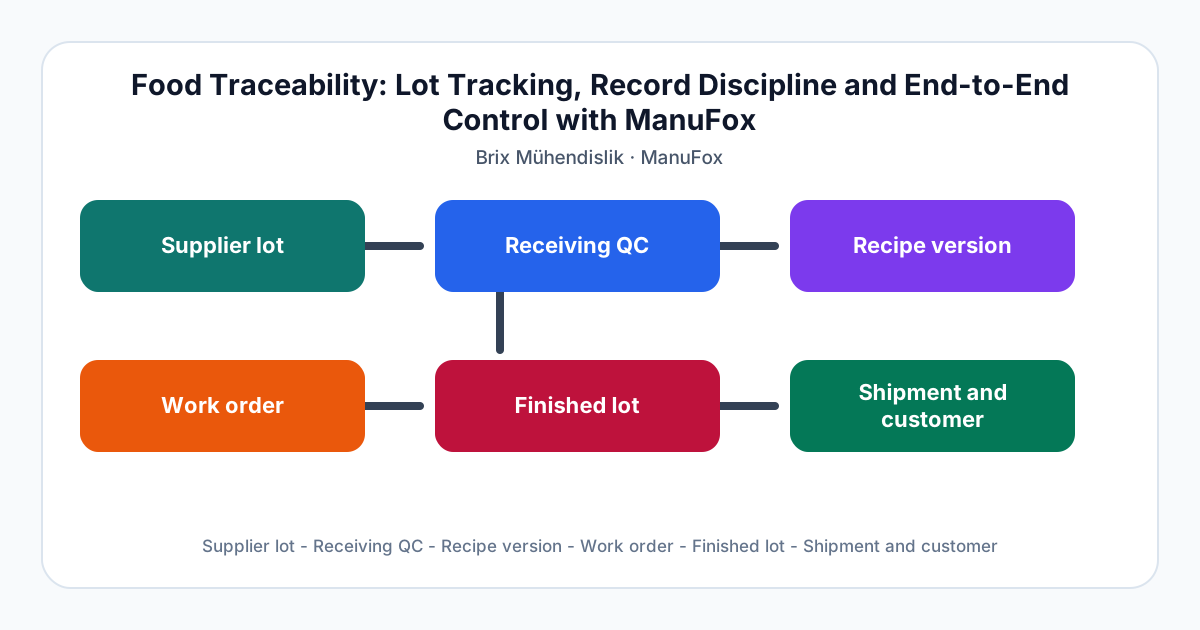
In practice, traceability means recording the right key data at every critical event. When receiving, production, quality and shipment records do not meet around the same lot identity, an investigation can take hours or days.
| Record point | Data to keep |
|---|---|
| Supplier lot | Supplier, batch, delivery note, certificate of analysis and receipt date |
| Receiving QC | Sample, test result, accept/reject decision and warehouse location |
| Recipe version | Formula, version, target yield, allergen and critical process parameters |
| Work order | Consumed lots, quantities, waste, rework, operator and time data |
| Finished lot | Finished lot, packaging, shelf life and quality release decision |
| Shipment and customer | Customer, shipment date, quantity, document and delivery details |
Where traceability data usually breaks
Most traceability failures start in process design before they become a software problem. Multiple lot formats for the same material, unrecorded rework or shipment documents without lot-customer links create uncertainty exactly when speed and evidence matter.
- Backward tracing slows down when supplier lot and internal lot are not matched.
- Mass balance becomes unreliable when partial consumption and transfers are not lot-based.
- Recall scope grows unnecessarily when rework is not recorded as a separate relationship.
- Quality decisions cannot be defended if release, rejection and conditional acceptance are not recorded.
- Customer notification becomes manual research if the shipment document does not carry the finished lot.
How ManuFox positions traceability in daily operations
ManuFox treats traceability not as a separate spreadsheet but as a result of normal operation. Material lots are recorded in stock movement, recipe versions in work orders, quality decisions in accept/reject flows and shipments in customer delivery records.
In its official positioning, ManuFox brings lot-based full traceability, quality control, recipe and cost management, production planning, shipment and recall support into the same food ERP backbone. That turns traceability from an after-the-fact form into a natural output of production data.
- Material management connects supplier lot, stock movement and minimum stock control.
- Receiving records can be read together with quality-control results.
- Recipe management separates which formula and version were used in production.
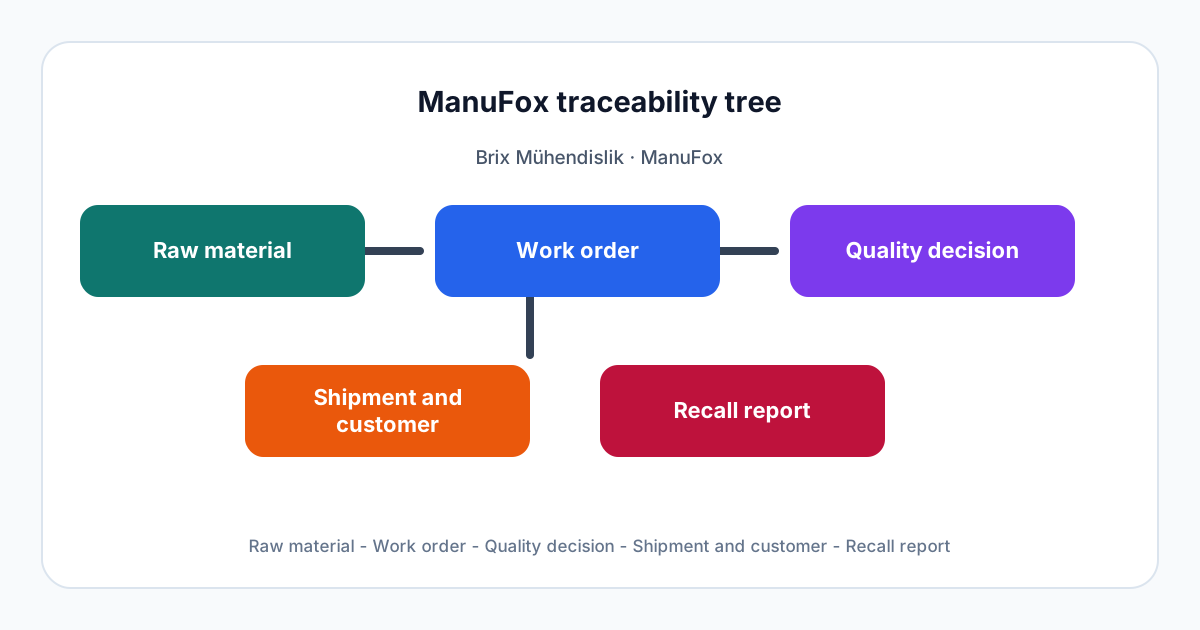
- The work order links consumed raw-material lots to the finished lot.
- Quality control keeps acceptance, rejection, conditional acceptance and sample results with an audit trail.
- Shipment management shows which customer received the finished lot and under which document.
- Recall support aims to report the forward and backward relationships of a problematic lot.
- Cloud access and backups help authorized teams reach records during a crisis.
- Cost and yield reports make traceability an operational improvement tool, not only a safety tool.
Implementation plan and control points
A traceability project does not end with software installation. It remains alive through lot-code standards, responsibility matrices, label discipline, data validation and regular drills.
- Create a lot-coding standard for finished goods, semi-finished goods, raw materials and packaging.
- Separate supplier lot and internal lot, but match them in the system.
- Prevent critical materials from entering production without receiving quality control.
- Freeze recipe versions and record the exact version used in the work order.
- Manage rework as a separate lot relationship.
- Record warehouse transfers and partial consumptions by lot.
- Make finished-lot and customer linkage mandatory in shipment.
- Run a monthly backward-and-forward trace test on a sample lot.
- Track test duration, record gaps and report accuracy as KPIs.
Audit and mock-trace metrics
The quality of a traceability system is proven by drill performance, not by attractive forms. If all raw-material lots, quality decisions and shipment customers for a random finished lot can be produced in under two hours, the system is operationally useful.
- Is the lot tree complete?
- Is the mass balance reasonable?
- Is rework visible separately?
- Are shelf life and warehouse location correct?
- Can shipments be listed by customer?
- Can an authorized team generate the report without outside help?
Conclusion
Food traceability becomes strong when daily records are trustworthy. When a food-focused ERP such as ManuFox keeps lot, quality, recipe, production and shipment data on the same foundation, traceability becomes more than an audit answer; it becomes a faster operating reflex.
Sources and ethical use note
No competitor sites or unclear-license sources were used. The external knowledge base was limited to official ManuFox pages, FDA public-domain materials, EUR-Lex legal text and the European Commission reuse policy. This article is not legal advice; food businesses should verify requirements against local regulations and customer standards.