Update, August 16, 2024: The regulatory gap discussed in this article was clarified by a newly published guide.
Guideline on the Turkish Food Codex Regulation on Nutrition Claims
Original publication date: April 15, 2023
In food labeling, the phrases sugar free and no added sugar are often treated as if they mean the same thing. They do not. This article explains the practical difference between these claims and why the wording matters for compliant product labels.
The discussion is based on Turkish food legislation as well as EU rules, EFSA opinions, FDA guidance, WHO definitions, and Codex Alimentarius references.
Part 1: The Sugar Free Claim
Under Turkish food legislation, a food can be labeled as sugar free when it contains no more than 0.5 g of sugars per 100 g or 100 ml. This threshold is about the sugar content of the final food, not whether sugar was intentionally added during production.

Note: Because understanding the sugar-free claim also helps explain low-sugar claims, this article focuses on sugar free and no added sugar rather than low sugar.
The key point is the legal definition of sugars. Polyols are excluded from the definition of sugars even though ingredients such as sorbitol and maltitol may chemically resemble mono- or disaccharides.
Definition of Sugars
Sugars: All monosaccharides and disaccharides present in food, excluding polyols.
Therefore, if a product naturally contains sugars, or contains sugars as a result of processing, but remains at or below the legal sugar-free threshold, it may be labeled as sugar free. A product containing maltitol or other polyols can also use the sugar-free claim when the final sugar content meets the requirement.
Part 2: No Added Sugar
The no added sugar claim is more complex because it focuses on whether mono- or disaccharides, or sweetening foods, were added to the product. Different authorities define this area with different levels of strictness.
EU-based rules, which Turkish legislation references, have historically been less explicit than FDA and Codex Alimentarius wording. That difference can create interpretation problems for manufacturers and label reviewers.
European Union Legislation
A no-added-sugar claim may be used only where the product does not contain added mono- or disaccharides or any other food used for its sweetening properties. If sugars are naturally present, the label should also state that the product contains naturally occurring sugars.
EFSA
In its scientific opinion on dietary reference values for carbohydrates and dietary fibre (2010), EFSA defines added sugars as sucrose, fructose, glucose, starch hydrolysates such as glucose syrup and high-fructose syrup, and other isolated sugar preparations used as such or added during food preparation and manufacturing. This definition does not include sugars in unsweetened fruit juice or honey. Total sugars comprise added sugars and endogenous sugars naturally present in fruits, vegetables and cereals, together with lactose in milk products. The US Institute of Medicine uses a similar definition (2006).
WHO
WHO (2015) distinguishes sugars within the structure of intact fruits and vegetables, sugars naturally present in milk such as lactose and galactose, and free sugars. Free sugars include mono- and disaccharides added by the manufacturer, cook or consumer, as well as sugars naturally present in honey, syrups, fruit juices and fruit juice concentrates. Unlike the EFSA added-sugars definition above, this definition includes sugars in juice, honey and syrups.
FDA
The FDA definition (2017) includes sugars added during processing or packaged as such: free sugars, mono- and disaccharides, sugars from syrups and honey, and sugars from concentrated fruit or vegetable juices when they exceed what would be expected from the same volume of 100% juice of the same type. Exceptions include 100% juice concentrates sold to consumers, such as frozen fruit juice concentrate, and certain sugars in fruit and vegetable juices, jellies, jams, preserves and fruit spreads.
Codex Alimentarius
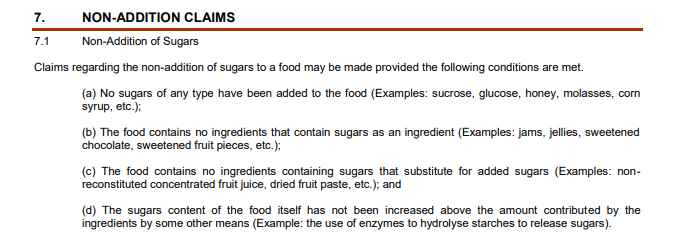
7. Non-addition claims — 7.1 Non-addition of sugars
A non-addition claim for sugars requires all of the following conditions:
(a) No sugars of any type have been added, for example sucrose, glucose, honey, molasses or corn syrup;
(b) The food contains no ingredients with added sugars, for example jams, jellies, sweetened chocolate or sweetened fruit pieces;
(c) It contains no sugar-containing ingredients that replace added sugars, for example non-reconstituted concentrated fruit juice or dried fruit paste; and
(d) Its sugar content has not been increased beyond that supplied by its ingredients through other means, for example enzymatic hydrolysis of starch to release sugars.
These definitions show why a label claim must be evaluated through the formulation, ingredient function, and final nutrition values together. A product can be sugar free but still fail the no-added-sugar logic, or it can contain naturally occurring sugars and still be eligible for a no-added-sugar statement if the required conditions are met.

Where Confusion Appears
One common source of confusion is whether the rule should be interpreted as “the food contains no mono- or disaccharides” or “no mono- or disaccharides were added.” The original EU wording points to the second interpretation: the focus is on added sugars, not every sugar molecule naturally present in the food.
Original EU Wording
A claim stating that sugars have not been added to a food may only be made where the product does not contain any added mono- or disaccharides or any other food used for its sweetening properties. If sugars are naturally present, the indication “contains naturally occurring sugars” should appear on the label.
What About Polyols?
Polyols create another practical question. For example, if a product naturally contains 5% sugar and maltitol is added, the product cannot be labeled sugar free because its sugar content exceeds the threshold. Whether it can be labeled no added sugar depends on the applicable interpretation of added mono- or disaccharides and the treatment of polyols in the relevant regulation or guidance.
This is why claim assessment should not be done from the front label alone. The full recipe, ingredient purpose, nutrition table, and target market legislation must be reviewed together.
The original article asked why polyols were not expressly excluded in this part of the wording. A maltitol-containing product with no more than 0.5% sugar could qualify as sugar free. Excluding a no-added-sugar claim for that same product without a scientific basis would appear inconsistent. Manufacturers should not have to resolve such ambiguity by guessing which interpretation the authority will adopt.
The following are the relevant excerpts from the FDA conditions discussed in the original article, rather than the complete set of conditions:
(i) No sugar as defined in § 101.9(c)(6)(ii), or sugar-containing ingredient that functionally replaces added sugar, is added during processing or packaging; and
(ii) The product contains no ingredient with added sugars, such as jam, jelly or concentrated fruit juice; and
The corresponding Codex condition expressly prohibits adding any type of sugar and gives sucrose, glucose, honey, molasses and corn syrup as examples.
Sweetening Ingredients
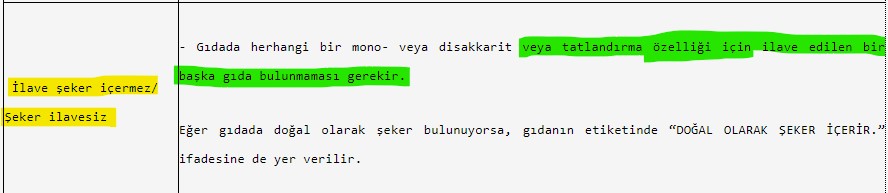
Another unclear area is the phrase “another food used for its sweetening properties.” If honey, fruit concentrate, dried fruit paste, or similar ingredients are added, the purpose of use becomes critical. In practice, this can be difficult to verify unless the rule is written clearly.
For example, a manufacturer adds honey and labels the product no added sugar. An inspector objects that honey was used for sweetening. The manufacturer replies that it was used as a binder, a filler or for its functional properties. How can the authority determine that purpose? It cannot read the manufacturer's intentions. The same difficulty arises with fruit juice concentrate and other sugar-containing ingredients used as sugar replacements.
The article argues that the FDA and Codex formulations address this ambiguity more explicitly through definitions and ingredient conditions. FDA addresses sugar-containing ingredients that functionally replace added sugar and ingredients containing added sugars. Codex lists examples including honey, non-reconstituted juice concentrate and dried fruit paste. These details make compliance less dependent on a manufacturer's stated intention.
Conclusion
Sugar free is mainly about the sugar content of the final product. No added sugar is mainly about what was added, why it was added, and whether any ingredient functions as a sugar or sugar substitute in the claim context.
For compliant labeling, manufacturers should evaluate the final sugar value, the ingredient list, the function of sweetening ingredients, and the legislation of the target market before approving a claim.
This discussion describes the ambiguity raised when the article was published in 2023. The update at the top links to the 2024 guidance that clarified the issue.